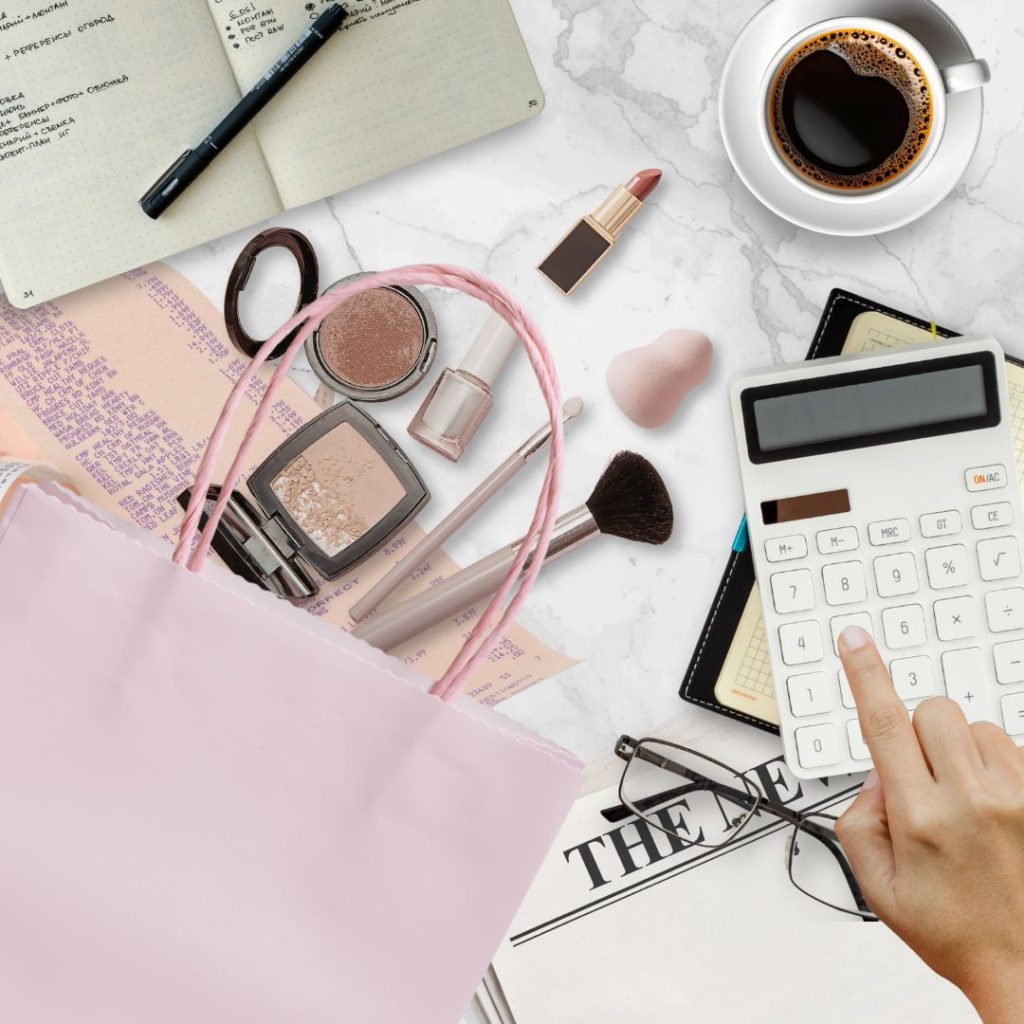
When budgets get tighter, priorities shift in a familiar way. Subscriptions usually go first, then dining out. Then the weekend trips you keep telling yourself you’ll book. But somewhere near the bottom of the list, behind groceries and utilities and transportation, sits a category many Filipinos refuse to cross out: beauty.
That instinct, of course, doesn’t exist in a vacuum. For households where every peso is already spoken for, beauty is one of the first thing that goes—and that’s a real and valid choice, too. But for a growing segment of Filipino consumers navigating economic pressure with some room still left to move, the relationship with the category is changing rather than disappearing.
For this group, spending on beauty isn’t impulsive or irrational. It’s considered. And economists, consumer researchers, and members of The Beauty Edit community are arriving at similar conclusions about why it stays.
The Economics of a Lipstick
This pattern even has a name: the lipstick effect, a trend economists have been pointing to for years. In the Great Depression, cosmetics sales surged 25 percent. After 9/11, Estée Lauder chairman Leonard Lauder noticed lipstick sales climbing across all his company’s brands and coined the term “Lipstick Index,” framing it as a counter-cyclical indicator. The pattern has repeated with remarkable consistency.
What explains it isn’t just vanity, but substitution with a psychological dimension. When larger pleasures become out of reach, people redirect toward smaller ones that still deliver a meaningful emotional return. A ₱500 lipstick can do something a ₱50,000 vacation cannot right now: It can happen today.
The data in recent years has held. From 2022 to 2024, the global beauty industry grew at 7 percent annually—outpacing inflation and overall consumer spending, according to McKinsey’s State of Beauty 2025 report. Even as budgets tightened under inflationary pressure, Circana reported that US prestige and mass beauty were among the top-performing retail categories in 2025. For the full year 2025, prestige beauty retail sales grew 4 percent year-on-year to reach $36 billion, while mass beauty rose 5 percent to $72.7 billion.
The New Spending Pattern in Beauty
What’s changed isn’t whether people spend on beauty, but how they decide what’s worth it.
McKinsey’s 2025 report surveyed more than 15,000 consumers across different markets and found that while the lipstick effect endures, consumers are now applying far greater scrutiny to what they buy. The era of “more is more,” as McKinsey put it, “has ceded ground to a new focus on value, differentiation, and individuality.”

Consumers are still spending, but spending more intentionally. Some products are seen as worth the splurge; others, less so. Fragrance shows the same pattern: prestige fragrance sales grew 6 percent in Q3 2025, while mass fragrance surged 17 percent in the same period.
“My Little Weakness and My Favorite Thrill”
We spoke to members of The Beauty Edit community across different age groups and lifestyles to understand how they’re approaching beauty spending right now and one thing is clear: even with tighter budgets, there are still categories people hold on to.
For Crissy Ramos, 40, the budget line for beauty spreads across categories—makeup, skincare, haircare, fragrance—but makeup always wins.
“There’s just something about new releases and fresh launches that I can’t resist,” she says. “A new lipstick, a beautiful palette, a formula everyone’s talking about; it’s my little weakness and my favorite thrill.”

Even with prices climbing, her spending hasn’t pulled back. If anything, she admits, she sometimes spends more than planned. The reason, she says, is rooted in something harder to quantify: reward. “I’ve realized it’s my way of rewarding myself for working hard. A little treat, a new beauty find, something I’ve been eyeing for a while; it just feels like a small celebration for everything I’ve pushed through.”
On what tips a spontaneous purchase, Ramos listed the factors without hesitation: events and new launches that make her curious about how a product will perform within her existing routine; influencers she admires, whose word effectively functions as an add-to-cart button. “No questions asked, if they rave about something, it usually goes straight to cart,” she said.
And last would be the price point, which she says is always part of the final decision.
Guilt, she says, is not part of the equation. “I work hard so I can shop a little harder.” And when something doesn’t end up working for her, she passes it on to friends or to family. “It all finds its way to someone who’ll enjoy it.”
“A beauty purchase feels worth it to me when it has visible results, it has practical value, gives me an elevated experience and of course, boosts my confidence,” says Ramos.
“Scent as Emotional Architecture”
Mads Constantino, a beauty enthusiast who works as a director for academic affairs, has a different hierarchy. For her, skincare is the foundation and fragrance is the philosophy.
“Skincare for me is foundational, because when my canvas is healthy and well-maintained, there is less need to rely on makeup for my daily look,” she says.
But it’s fragrance that she describes in terms that go beyond product: “I’ve always seen scent as emotional architecture. It shapes my mood, anchors certain memories and stories, and creates my own ‘personal atmosphere.'”
“Beauty is an integral part of my self-investment. It is how I choose to care for and present myself.”—Mads Constantino, Director for Academic Affairs
She calls it her “spray-on aura.” And that framing—scent as extension of self rather than accessory—reflects a shift in how fragrance is being consumed. A McKinsey report highlighted fragrance as the fastest-growing beauty category, with an expected 8 percent compound annual growth rate through 2030. Across markets, both prestige and mass fragrance have surged, reflecting how scent has steadily become a more central part of everyday beauty routines.
For Constantino, unplanned purchases follow a specific logic: thoughtful innovation and beautiful, functional design. Her favorite reference point is Issy, the local brand whose approach she describes as “highly considered, cerebral, and sexy.” The appeal is in the adaptability—products that are multi-use and conceptually cohesive.
She has also reframed how she thinks about beauty spending as a category of self-investment, deliberately pushing back against cultural narratives that dismiss it as vanity: “I’ve become very conscious of reframing the narrative around beauty, having grown up in an environment where it is often dismissed as something trivial. Beauty is an integral part of my self-investment. It is how I choose to care for and present myself.”
For Constantino, guilt is simply not something that applies. “It always feels earned and it is always empowering. There is no space for guilt in something that contributes to my sense of self and well-being.”
“Dress for the Future You Want”
Simon Domingo, a 29-year-old executive coordinator, only recently got into more serious beauty spending. He started collecting fragrances in August 2025—and it picked up quickly.
“Recently, I’ve started investing more in skincare, makeup, and fragrances. I would say though that most of it would go to fragrances since I started collecting in August 2025,” Domingo says. “I’m a very emotionally-driven person, so when it comes to fragrances that capture a core memory, I would usually buy it. For example, if I go to a new city and there are local fragrances that remind me of that city, I would fold almost instantly.”
It’s a behavior that reflects something McKinsey’s consumer research identified: among Gen Z and younger consumers, beauty spending becomes more about experience and memory-making. Beauty categories linked to identity, emotion, and personal narrative tend to hold their grip even in tighter times.
Domingo, though, is also realistic about the economics: “I would think that beauty and grooming would be the first to go during these times because we really have to prioritize where our money goes. Between utilities, food, and transportation, beauty and grooming become a ‘luxury’ that would fall in priority for most.”
But the spending continues because of what it represents. “Being able to give myself that little pick-me-up that new skincare, makeup, or fragrances afford really goes a long way. It keeps me going and reminds me that things might not be okay right now, but it too shall pass.”
“Beauty feels worth it when it empowers you to be the best version of yourself. When you feel good about yourself, it affects the way you present yourself and hopefully it also affects the people around you.”—Simon Domingo, 29, Executive Coordinator
He borrows a phrase from a former boss that echoes the sentiment: We have to dress for the future we want.
And for him, “I choose to dress myself up for a better tomorrow.”
A beauty purchase, for Domingo, rarely triggers guilt because the product is never just a product. “When I look at the makeup, skincare, or fragrances that I buy, I don’t see products. I see people, events, and memories that only those items can trigger.”
“Beauty feels worth it when it empowers you to be the best version of yourself. When you feel good about yourself, it affects the way you present yourself and hopefully it also affects the people around you. Seeing people happy with their makeup, better skin, or simply smelling good is the best and most infectious dopamine boost we can count on during these trying times.”
“Whatever Is Left Becomes Room for Small Treats”
Karla Ray Mendoza’s approach to beauty spending is perhaps the most pragmatic of the four, but it lands in the same emotional place as everyone else.
Sunscreen is the 27-year-old corporate professional’s non-negotiable, and she doesn’t frame it as beauty at all. “It feels less like a beauty product and more like protection for my future self,” she says.
“After that, makeup naturally takes space in my budget–not in an overly heavy or complicated way, but as something that helps me feel ready to face the day. On most days, it’s skincare and makeup that quietly take priority, because they’re part of my everyday rhythm.”
Inflation has made her more intentional but not more restrictive. “I still buy the things I love, but I’ve started distinguishing between what I need to consistently maintain and what I simply enjoy.”
“Skincare and makeup remain steady, while things like fragrances—which I’ve recently started collecting—have become more of a slow, intentional indulgence rather than an impulse. It’s less about stopping myself and more about pacing myself,” she says.
“A purchase feels worth it when it integrates naturally into my life—when it works for my skin, feels good to use, and delivers on what it promises. But beyond that, it’s also emotional. If something makes me feel more like myself—more put together, more confident, more at ease—then it’s always worth it.”—Karla Ray Mendoza, 27, Corporate Professional
What tips an unplanned purchase for Mendoza are timing and trust. “When I see discounts on brands I already trust, it feels less like a risky purchase and more like an opportunity I don’t want to miss.” Pre-existing knowledge of a product also lowers the barrier. “There’s also something about already knowing a product works for me—that reassurance makes it easier to say yes even if I wasn’t planning to,” she said
Beauty, for Mendoza, sits somewhere between essential and treat, and she’s at peace with that duality. “Beauty is practical for me—it’s part of how I show up for work and daily responsibilities, but it also holds space as a small form of joy. I make sure my essentials are covered first, and whatever is left becomes room for small treats that make life feel a little lighter.”
Investing in herself in small ways, she says, makes her feel more grounded and confident in the work she does.
“A purchase feels worth it when it integrates naturally into my life—when it works for my skin, feels good to use, and delivers on what it promises. But beyond that, it’s also emotional. If something makes me feel more like myself—more put together, more confident, more at ease—then it’s always worth it.”
What the Spending Actually Means
Across these four different beauty consumers—a makeup lover who rewards herself after hard work, a fragrance collector who sees scent as self-architecture, a new collector who builds memories through scent and beauty products, and a beauty consumer who moves between practicality and quiet indulgence in her routine, spending isn’t a failure of discipline but a form of maintenance not just of skin and appearance, but of self.
This, in a sense, is what the lipstick effect has always been pointing toward and what pure economic framing sometimes misses. The $15 lipstick (or the ₱500 blush, or the niche fragrance that costs more than a grocery run) isn’t purchased despite hard times but could be purchased because of them. Because when the larger structures feel uncertain, beauty offers something immediate, personal, and entirely within reach.