There is a specific kind of unease that comes with scrolling past a review that feels just slightly off. The skin is too even. The caption reads like a summary of a hundred other captions. The enthusiasm is frictionless. You save it anyway, or you don’t, but the feeling lingers: Was any of that real?
This is the conversation the beauty space has been circling for a while now, and it’s time to have it plainly. Not as an indictment, and not as a rejection of AI outright—but as an honest look at what’s shifting, what it means for everyone in this ecosystem, and where the line actually sits.
It Was Always About the Person
Brands don’t choose a creator for a pretty grid. They choose the persona—the skin type, the routine, the 11 PM opinion on whether a serum actually works. From the beginning, influencer culture was built on borrowed trust: a transfer of credibility from someone an audience believes in, to a product they’ve never tried.
Monique Buensalido, Vice President for Business Development & Operations in Buensalido PR & Communications, puts it plainly: “When we find and recommend creators to work with, we always choose those who have a unique point of view and whose content connects deeply with our target market. When content is distinct and original, it always performs better than a generic one.”
When a brand books a specific creator, they’re paying for exactly that—her expertise, her opinion, her lived experience. Not a rendered version of it.
That distinction—between the real person and the rendered version—used to be obvious. Now it requires a second look.
The Body Is the Evidence
Beauty is one of the few categories where the body is the proof. A skincare recommendation means something because that specific person’s skin—their barrier, their climate, their lifestyle—responded to that formula. A foundation review lands because you watched it perform on their skin, in real light, over time.
The same goes for the words—how a review is paced and phrased. When a caption is written by AI, it may be polished and accurate, but it’s no longer that creator’s voice working through what the product actually felt like. The hesitation. The comparison to something she used five years ago. That texture of thought is what makes a recommendation feel real.

“It [content] can feel less like storytelling and more like optimization.”—Lui Diongco, Content Creator
Content creator Lui Diongco describes the shift this way: When AI starts shaping the content, the collaboration risks diluting the very thing brands are paying for—the real voice, the lived experience, the credibility that comes from someone who actually tried it. What people follow isn’t a persona. It’s a perspective built from actual experience. That part can’t be generated.
Where It Gets Complicated
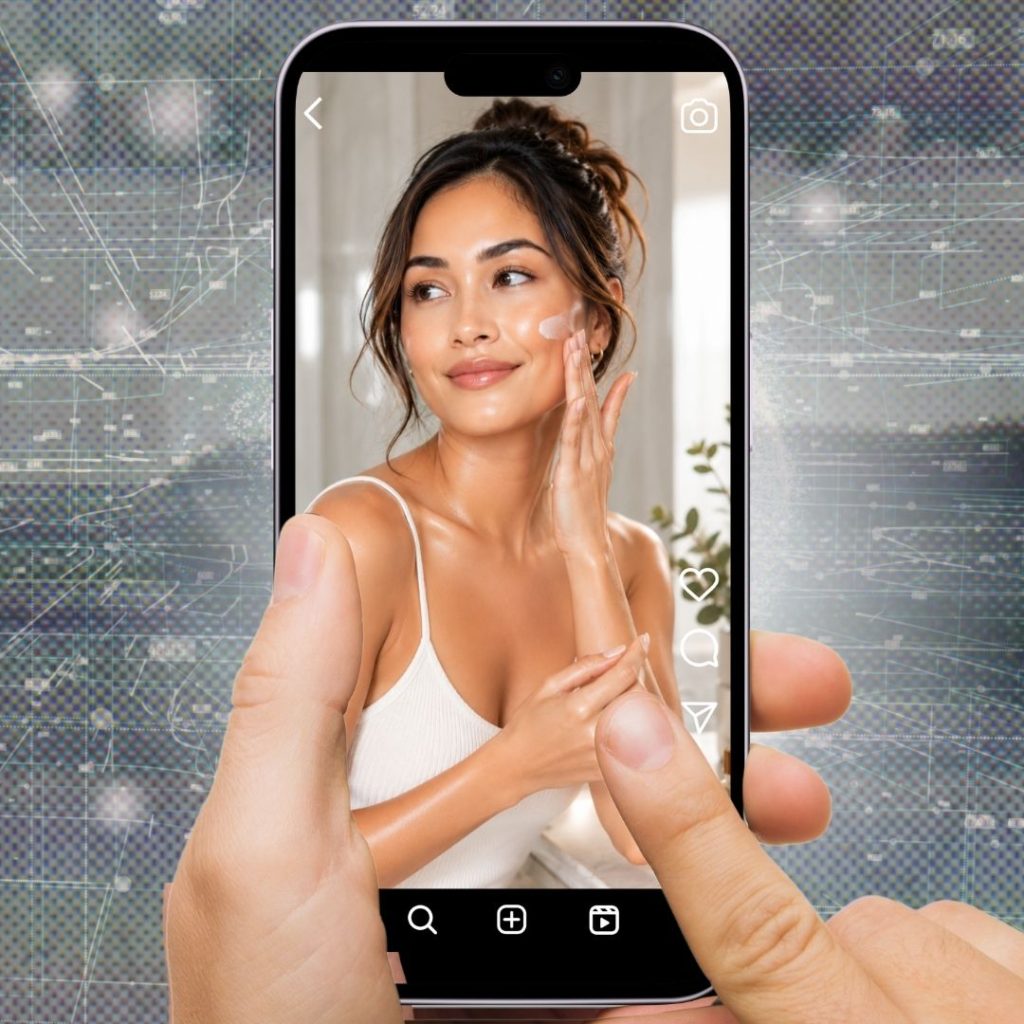
We’re not talking about virtual influencers—fully digital personas that at least operate with their artificiality disclosed. The more layered conversation is closer to home: real, trusted, human creators posting AI-generated images of themselves using a product they were paid to promote. Or publishing captions written entirely by AI—ones that describe a sensory experience in language that was never actually theirs.
The “morning routine glow” was rendered. The caption describing how the serum absorbed into her skin was drafted by a model trained on thousands of other reviews. And the specific wrongness of it—the thing that registers as that slight uncanny feeling when you scroll past—is that it borrows the authority of lived experience while having none of it.
This isn’t always deceptive by intent. Sometimes a creator genuinely loved a product and still reached for AI tools to present it. But the line between using AI as a production tool and using it to stand in for actual experience is worth knowing—because it’s getting harder to see. “It [content] can feel less like storytelling and more like optimization,” says Diongco.
What makes this harder to navigate is that disclosure doesn’t cleanly solve it. A 2025 study published in the Journal of Marketing & Social Research found that explicitly disclosing AI use doesn’t rebuild trust—it actually drops it further. Transparency doesn’t rescue the problem. It confirms it.
Three Things That Shift
When AI enters a beauty review—whether in the imagery, the caption, or both—three things shift for everyone involved.
The creator presents a result her audience can’t fully claim as her own. The brand receives an endorsement built on content that may not reflect a real experience with the product. The audience encounters a review that looks lived-in—but may have been generated.
None of these is a catastrophic failure on its own. Together, they hollow out the exchange for everyone in it.
The Skepticism Is Already There
We didn’t arrive at this conversation without reason. We are already the most skeptical beauty audience there has ever been. According to Accenture’s Life Trends 2025 report, over half of consumers today doubt the authenticity of what they see online, and 62 percent say trust is now a deciding factor in whether they engage with a brand at all—up from 56 percent just two years ago.
That ambient skepticism is the water we’re all swimming in. Which means the bar for what counts as a genuine recommendation has never been higher. AI-generated content can be just as engaging as real content—research confirms this. But engagement and trust are not the same thing. In beauty, trust is the only currency that actually converts.
Creativity Isn’t a Deliverable
There is a reason a brand chooses this creator over any other. They are choosing her angle on light, her way of describing a texture, her instinct for what her community will actually believe. That editorial sensibility—the specific way someone sees and articulates beauty—is creative and intellectual work. It is also critical that the thing being sold is in an influencer partnership.
Danica Lloren, Executive Vice President of Visions PR, frames it well: “AI should serve as support—refining, optimizing, or enhancing content—and not replacing the creator’s voice or perspective.” When AI writes the caption wholesale or generates the image outright, what’s being exchanged starts to look less like a genuine endorsement and more like a very personalized-seeming advertisement.
The distinction matters—to the audience, and eventually, to the brand. You cannot automate your way into credibility.
Things Worth Noticing
This is not a checklist—just some things worth sitting with the next time you save a review.
Does the skin look like skin—or like an idea of skin? Real complexions have texture, variation, and inconsistency. AI-generated imagery tends toward an evenness that no skincare product actually produces.
Does the caption read like a person or a summary? Real reviews have friction—the product that worked only in dry weather, the scent she had to get used to, the comparison no algorithm would think to make. Frictionless enthusiasm is often a flag.
Does this creator have a history with this product? One post doesn’t tell you much. Patterns do.
You don’t need to audit every post you see. But you’re allowed to trust what you already sense.
Where We Stand
We are not anti-AI. We use it for research, efficiency, and operational work—and we’ll say so when we do. But a review is not a production asset. A recommendation is not something that can be outsourced to an algorithm. A skincare result is not a render. And a caption describing how something felt on someone’s skin should come from that person’s skin.
“Authenticity shouldn’t be assumed anymore—it has to be designed and protected.”—Monique Buensalido, Vice President for Business Development & Operations in Buensalido PR & Communications
Buensalido recommends that brands proactively build their own policies for how creators should use and disclose AI in paid partnerships—because the regulatory landscape will always move more slowly than the technology. The question isn’t whether AI belongs in beauty content. It clearly does, in many forms.
The question is where it stops being a tool and starts replacing the only thing that made the content worth trusting. In recommendations, that line is the experience itself.
The beauty space has always been in the business of aspiration. It has also, at its best, been in the business of truth—real formulas, real skin, real results. Those two things have always been in tension. AI doesn’t create that tension. It just makes it more visible and more urgent to resolve.